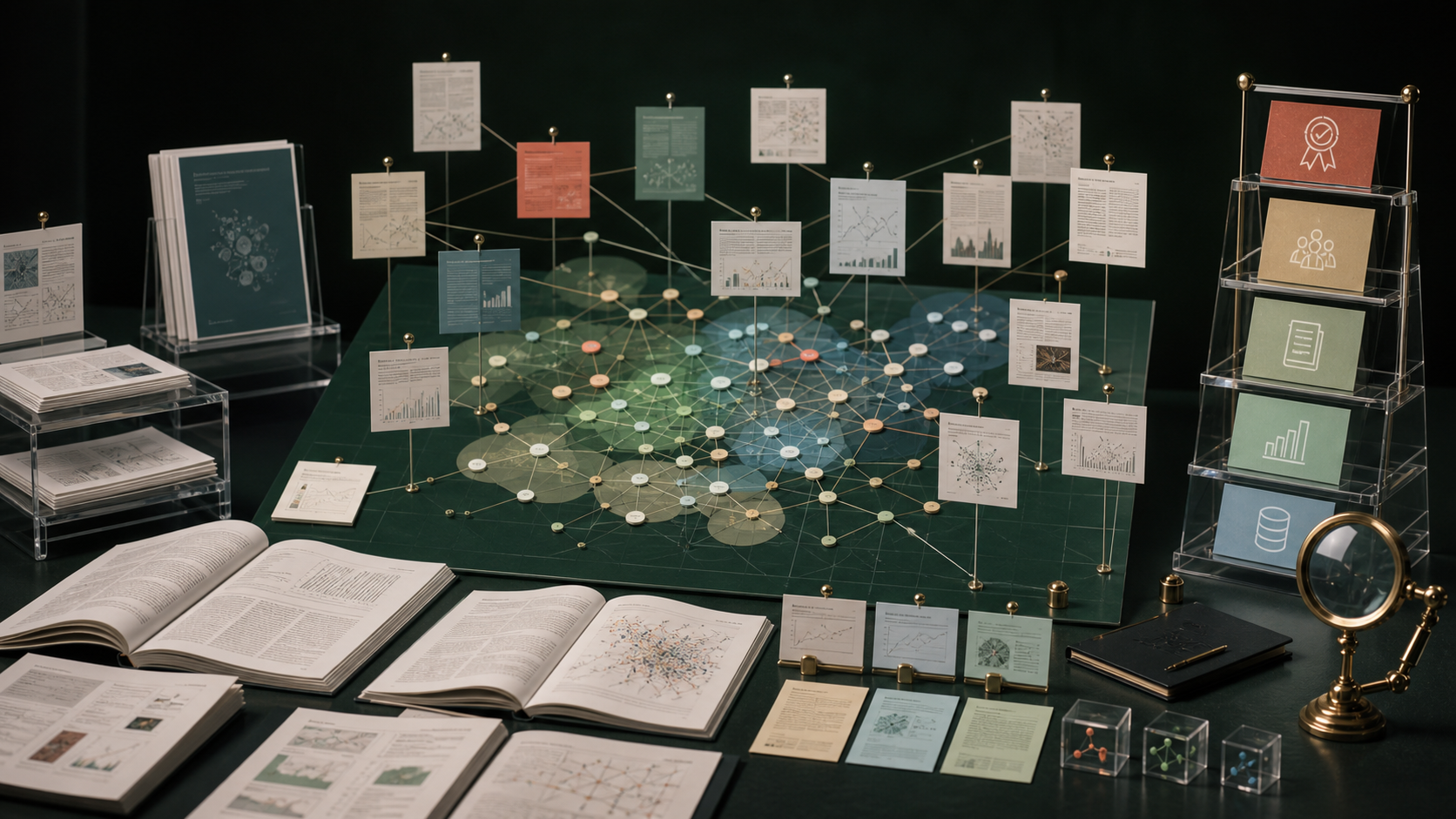
When you are considering a STEM PhD, the name of a programme or vacancy rarely tells you enough. A title such as “data-driven materials”, “computational biology”, or “energy systems” can describe many different questions, methods, and working environments. You need to understand what researchers in that area are actually asking, what evidence they use, which terms they use for the same problem, and where the current work is happening.
Journals and publications are useful for that job, but only when you use them as a map rather than as a scoreboard. A journal scope can show you the boundaries of an area. Recent articles can show you questions and methods. DOI records can help you follow a paper to related outputs. A society, research centre, or public research organisation can add the vocabulary and wider context that one journal issue cannot provide. A researcher record can help you locate work, while an institutional page is still needed to confirm a current role.
This guide gives you a repeatable way to move from a broad interest to a field note you can trust. It is written for an applicant who may be entering a new area and does not yet know every term. You do not need to read hundreds of papers. You need to read a small, well-chosen set carefully, keep source ownership clear, and record what the evidence does and does not show.
The guide does not rank journals, recommend a single “best” publication, or judge a supervisor from a publication list. It also is not a literature review of one discipline. The aim is to help you understand a research area well enough to decide which fields, groups, and opportunities deserve closer checking.
The short answer: map the field before you judge a place
Start with a question you could imagine researching, not just a degree label. Find two or three journals or publication venues whose official scope covers that question. Read their scope pages and a small sample of recent articles. For each article, record the question, method, evidence, authors, affiliations, and stated limitation. Use DOI metadata to follow related work, but verify the paper on the publisher or journal page. Use a learned society, centre, or research organisation to learn the field's shared terms and current priorities. Use ORCID only to discover works and possible affiliations, then confirm the person's current role on an institutional page.
Put these notes into a field map. The map should connect questions, methods, evidence, datasets or facilities, groups, and open issues. Keep a separate column for facts you can support and another for your own interpretation. When a source is silent, write “not stated” instead of filling the gap with an assumption.
The result is not a ranking. It is a decision record. It can tell you whether a field is close to your preparation, which methods you would need to learn, whether a group is working on questions that interest you, and which unknowns you must ask about before you apply. It can also tell you to stop. If the field's questions, methods, or training context do not fit your goals, learning that before a long application is a useful outcome.
Begin with a field question, not a keyword cloud
An unfamiliar field usually looks larger than it is because search results mix broad labels, commercial language, old terminology, and neighbouring topics. The first step is to turn your interest into a question that can guide reading. You are not writing a proposal at this stage. You are creating a temporary lens.
Separate the problem from the label
Write the broad label you started with, then ask what you mean by it. “Artificial intelligence in healthcare” might mean clinical prediction, medical imaging, health-service operations, safety evaluation, human-computer interaction, or many other areas. “Climate research” might mean atmospheric measurement, adaptation policy, energy modelling, ecology, or risk analysis. A label is a useful entry point, but it cannot tell you which papers or groups are relevant.
Try a sentence such as: “I want to understand how [a system or process] changes when [a condition or intervention], using [a kind of evidence or method].” The brackets are prompts, not a final research question. You can leave a bracket open if you genuinely do not know yet. The purpose is to create enough specificity to recognise relevant work.
For example, an applicant interested in energy might begin with “How can faults in renewable-energy infrastructure be detected from field data?” That sentence points towards monitoring, signal processing, reliability, and infrastructure research. An applicant interested in biology might write “How do microbial communities respond to a pollutant in a controlled environment?” That points towards experimental design, sequencing, ecology, and environmental health. Neither example claims that one field owns the question. It gives the reader terms to test.
Mark what you already know and what you need to learn
Make two short columns. In the first, write the methods, subjects, or theories you can already explain. In the second, write the words and practices you do not yet understand. This is more useful than pretending to be familiar with an entire discipline. It also helps you choose papers at a manageable level.
If you have used a method in another context, describe the transferable part without claiming that the contexts are identical. A statistics student may know model evaluation but not the domain-specific meaning of a clinical outcome. A materials student may understand microscopy but not the manufacturing constraints of a new device. These differences are normal. Your field map should make them visible so that you can learn them before making a fit claim.
Use a third note for boundaries. State what you are not trying to study in this first pass. If you are learning computational biology, you might set aside clinical implementation and focus on the methods used to compare biological sequences. If you are learning robotics, you might set aside hardware design and begin with perception and control. A boundary keeps reading purposeful. You can change it later when the literature shows that the areas are connected.
Build a small vocabulary from authoritative pages
Before you search for papers, collect terms from official journal scopes, society pages, and research-organisation descriptions. Look for repeated nouns and verbs. Nouns may include a system, material, population, or dataset. Verbs may include estimate, characterise, detect, optimise, simulate, compare, or explain. Record synonyms and older terms separately. A field can use two words for closely related ideas, while a similar word in another field may mean something different.
Do not treat a search engine's suggested phrase as a definition. Search suggestions reflect what people type, not what a field means. A publisher's scope page tells you what that journal says it covers. A society's glossary or overview may explain a term for members of the field. A research centre may use a local project term that is useful for finding its work but not a universal definition.
When you add a term to your note, write where it came from and what you think it means. If two sources use it differently, keep both meanings and mark the difference. This small record prevents a common mistake: copying a word from a paper into a research statement without understanding the boundary the authors gave it.
Choose a reading question for each session
Reading becomes inefficient when the goal is simply “learn the field”. Give each session a question. You might ask: What problem is this journal interested in? Which methods are recurring? What type of evidence counts as a convincing result? Which limitations appear across several papers? Which groups are active in this question? A session should answer one or two of these, not everything at once.
Keep the question beside your notes. If a paper does not help answer it, you can stop reading without feeling that you failed. This is especially important when you are working in a second language or entering a field with unfamiliar mathematical or experimental conventions.
Read journal scope and publisher information as evidence
Once you have a provisional question, identify journals that actually publish work near it. The goal is not to find the most famous title. The goal is to understand how the field describes its own boundaries and where relevant work is visible.
Use discovery tools, then return to the controlling page
The Directory of Open Access Journals, or DOAJ, can help you discover open-access journals and inspect the information those journals provide. It is a discovery and transparency resource. Its inclusion of a journal is not a complete judgement of every article, editor, or research group, and a journal's absence from DOAJ is not proof that it is poor. Many journals use a subscription or mixed model.
After finding a candidate, open the journal's own publisher or learned-society page. That page controls the journal's stated scope, audience, article types, and instructions. Search snippets, third-party lists, and an old profile can point you to a title, but they cannot replace the current publisher page.
Make a record for each candidate journal with its exact title, publisher or society, scope URL, and the date you read the page. Copy only a short phrase when you need it for your notes. In your own words, explain how the scope relates to your field question. If the connection is weak, remove the journal from the active set. A shorter list is easier to read properly.
Read the scope for boundaries, not marketing words
Scope pages often use broad language. Read for the nouns and the limits. Does the journal describe a particular system, population, method, or kind of contribution? Does it mention both fundamental and applied work? Does it publish research articles, reviews, methods papers, data papers, or commentary? A journal that appears relevant from its title may focus on a different level of analysis or a different kind of evidence.
Separate what the journal says from what you infer. “The journal states that it covers remote sensing and environmental monitoring” is a source-backed note. “This is the leading journal for my topic” is a ranking claim that needs evidence and is usually not necessary. Your decision does not require a superlative.
If the scope has changed, use the current page and note that a recent issue may still reflect an earlier editorial direction. A journal's older archive is useful for tracing a field's history, but it should not be treated as current evidence of the present scope.
Check article types before you interpret the contents
Journals publish different kinds of material. An original research article may present a new dataset or experiment. A review may synthesise existing work. A methods paper may focus on a tool or protocol. An editorial or perspective can show a debate without being primary evidence for a scientific result. A data paper may describe a resource rather than answer a substantive question.
When you read a table of contents, label the article type. Otherwise you may treat a perspective's argument as a measured finding or a review's summary as a new experiment. Article-type labels also help you choose your first reading set. A new reader might begin with one accessible review to learn the vocabulary, then move to original studies to understand how claims are supported.
Read recent issues with a purpose
Look at a manageable recent window, such as the latest issue pages or a selected group of recent articles. Do not infer a field from one issue. Note recurring questions, methods, data sources, and author affiliations. If the journal has an archive, compare recent material with an older period only when you need to see a change in language or methods.
Record the article title, date as shown by the publisher, type, and link. You do not need to copy every author or abstract. Highlight papers that sit close to your field question and set aside papers that only share a broad keyword. If several papers address the same problem with different methods, mark that as a possible sub-area rather than deciding which method is best.
Use the publisher page to check the paper's identity
Before quoting or relying on a paper, confirm its title, authors, publication status, DOI, and article type on the publisher page. A preprint, accepted manuscript, early-online article, and version of record may have different dates or details. The publisher page may also link to corrections, retractions, supplementary material, or a data statement. You do not need to become a publishing expert, but you should know which version you read.
If you cannot access the full text, do not pretend that you reviewed the methods or results. You can use the abstract and metadata for discovery, then mark the evidence as limited. A field map can include a paper you have only screened, as long as the note says what you actually saw.
Read recent articles strategically
You do not need a large bibliography to understand a field. You need a small set that exposes the field's questions, evidence, methods, and limits. A useful first set might include one recent review, two or three original studies close to your question, and one paper that uses a different method or reaches a different kind of conclusion. The exact number depends on the field and your starting knowledge.
Begin with the title, abstract, and keywords
Read the title and abstract once without making a judgement. Identify the subject, the action, the setting, and the main result the authors report. Then read the keywords or indexing terms. Compare these with your vocabulary note. A word that appears in several papers may be a useful field term. A word that appears only once may be a local choice or a narrow method.
Write a two-sentence summary in plain language. The first sentence says what the study set out to examine. The second says what the authors found or contributed, with the level of certainty they use. Avoid replacing “associated with” or “consistent with” with “caused”. Avoid converting a method paper into a claim about a field-wide solution.
Locate the research question and its reason
The introduction usually explains what gap or problem the paper addresses. Ask what the authors already assume the reader knows. This reveals the field's background vocabulary and the problem that motivates the work. It can also show that two papers use the same broad label for different questions.
Write the research question as a question, even if the paper gives it as an objective or hypothesis. Note why the question matters to the authors and which earlier work they use to frame it. You do not need to record every citation. Follow a few key references when you need to understand a term or earlier finding.
Check whether the paper is asking a descriptive, explanatory, predictive, design, or evaluative question. The same word, such as “performance”, can mean a measured outcome, a model's prediction, a device's efficiency, or a user's experience. The question type affects what counts as evidence and how you should compare the paper with others.
Read the method as a design choice
Method sections can feel difficult when you are new to the field. You do not need to reproduce every equation on the first pass. Start by identifying the unit of analysis, the data or materials, the procedure, the comparison, and the outcome. For a computational paper, note the dataset, model, baseline, evaluation measure, and validation design. For an experimental paper, note the sample, controls, intervention, measurement, and replication or uncertainty information. For a qualitative or mixed-method study, note the setting, participants or documents, collection process, analytic approach, and evidence used to support interpretation.
Ask why the authors chose this design. What question can it answer? What question cannot it answer? This distinction is more useful for field learning than memorising the method's name. Two papers may both use machine learning but have different goals, data-generating processes, and limits. Two experimental studies may use the same instrument but investigate different mechanisms.
Record what is fixed by the field and what is chosen by the authors. A measurement standard may be widely used, while a sampling decision may be particular to the study. If you are considering a PhD, this helps you see where a possible contribution could sit: a new question, a new dataset, a better design, a transfer to another setting, or a clearer explanation of a known result.
Read results with the claims beside the evidence
Read the figures, tables, and result paragraphs together. Ask which result directly answers the research question and which is a secondary analysis. Record the comparison or baseline, not only the headline number. If the paper uses statistical estimates, note the uncertainty or interval reported. If it uses a qualitative interpretation, note the material or cases that support it. If it proposes a system, note the test setting and the conditions under which the result was observed.
Do not copy a result without its context. A model that performs well on one dataset may not generalise to a different population. A laboratory effect may not appear under field conditions. A survey association may not establish a causal mechanism. The paper's methods and limitations should stay attached to your summary.
When you compare papers, keep their outcomes separate. A higher value may not mean a better result if the measures, data, or goals differ. You can write “These papers address a related problem with different outcomes” instead of forcing them into a league table.
Read limitations as field signals
Authors often state limitations near the end of the discussion. These are not an admission that the study is useless. They tell you where the evidence is narrow and what a careful next study might examine. Record whether the limit concerns data coverage, measurement, sample, model assumptions, external validity, missing comparison, or interpretation.
Look for limitations that recur across several papers. Repeated limits may indicate a live field problem, a difficult measurement, or a trade-off between methods. Do not call a repeated limitation an “unanswered gap” until you understand why it persists. A gap may be difficult because a dataset is unavailable, a method is expensive, a population is hard to reach, or ethical rules constrain the design.
Use references as a route to earlier work, not as proof of quality
References help you learn the history of a question and identify terms that the field treats as important. Follow a cited paper when the current article depends on it for a definition, a method, or an earlier result. Do not assume that a paper is correct because it has many citations or appears in a prestigious journal. Citation count is not a substitute for reading the work or checking the claim.
Make a note of whether the cited source is a primary study, review, standard, dataset, protocol, or policy document. A review can point you to a set of studies, but a direct claim about a result should normally be checked against the primary paper when the decision matters.
Read across methods and viewpoints
Fields often contain multiple traditions. One group may use experiments, another simulations, another field observations, and another social or policy analysis. Reading only one method can make a field look more settled or more narrow than it is. Choose at least one paper that approaches your question differently, then write what the methods make visible and what they leave out.
This does not mean that every method is equally appropriate for every question. It means you should understand the reason for the difference before choosing a route. A PhD project may combine methods, translate between them, or focus on improving one method. Your field map becomes stronger when it shows those relationships rather than presenting a single method as the field's identity.
Use DOI and metadata records carefully
DOI records are valuable because they provide a persistent identifier and a way to follow relationships between publications. Crossref explains that metadata is enriched through member updates, community feedback, automated matching, and other sources. That makes it useful for discovery, but it also means that a record can be incomplete, delayed, or inconsistent with another source.
What a DOI record can help you find
Use a DOI to locate the version of a paper, confirm its title and publication relationship, and find connected records such as a correction, a dataset, a preprint, or supplementary material when those relationships are deposited. The record can help you move from a citation in one paper to the publisher page of another. It can also reveal the journal, publisher, and date fields that help you sort your reading list.
Keep the DOI as a stable identifier in your field note. Store the publisher URL beside it. If the DOI resolves to a landing page with several versions, record which version you read and why. This avoids a common mistake in which an applicant cites a preprint while describing a later version-of-record result.
What metadata cannot establish
Metadata does not tell you whether a paper's method is sound, whether a researcher is currently employed by an institution, whether a group is accepting students, or whether an opportunity is funded. A Crossref record may carry an affiliation that reflects the publication time. It may also omit a current affiliation or contain fields supplied by different contributors.
Treat the record as a pointer. For a current role, open the institution's staff or research-group page. For a current project, open the funder, employer, or opportunity page. For a claim about a result, read the paper itself. The source that owns the decision or statement should be the source you cite.
Resolve differences without guessing
If the DOI record, publisher page, and author profile disagree, list the conflict. Check whether one refers to an early publication date, a correction, or an old affiliation. Do not silently choose the version that fits your story. If the difference matters to your application decision, ask the relevant office or leave the point unresolved.
This habit is simple but important. A field map that preserves uncertainty is more useful than a polished map built from false precision.
Use societies, centres, and research organisations to widen the map
A journal shows a slice of published work. Learned societies, professional associations, research centres, and primary research organisations add language, community structure, facilities, policy context, and public priorities. They can help you understand how the field connects beyond individual articles.
Learn the field's shared vocabulary
Society pages often explain a field for members, students, or the public. Look for topic overviews, position statements, conference themes, training pages, and technical resources. These pages may make a distinction that journal titles do not. Record the terms they use, but keep their purpose clear. A society page may represent a community or professional interest; it is not necessarily evidence for a scientific result.
Use these pages to improve your searches. If a society consistently uses a term that does not appear in your original keyword list, add it as a possible synonym. If it separates two ideas that you had combined, split them in your field note and see whether the journals follow the same boundary.
Find centres through current research, not logos
Research-centre pages can reveal themes, facilities, projects, partners, and member lists. They are useful for finding groups and understanding how a university or organisation organises work. Read the current projects and recent updates, not only the centre's mission statement. A centre may host many projects across several fields, and its name alone does not prove that a particular supervisor or vacancy belongs to the area you are exploring.
Follow a project link to its funder, employer, or official recruitment page when you need to know whether it is active or hiring. A news item about a completed grant is useful historical context but is not a current opportunity. Mark the difference in your notes.
Check who owns a claim
A public research organisation may publish a report, dataset, standard, or policy document. A university centre may publish a project description. A society may publish guidance or a position statement. Write down which organisation owns the item and what kind of claim it can support. A policy report may describe a priority, while a journal article may test a research question. A centre page can show that a facility exists, while a vacancy or student page must explain whether an applicant can use it.
This source ownership makes your field map more honest. It also prevents a marketing page from becoming evidence of a scientific result or funding promise.
Use training and network pages as context
Doctoral networks and training partnerships can help you see the methods, facilities, and collaborations that a field uses. The official MSCA Doctoral Networks page, for example, describes a structure in which institutions collaborate on doctoral training. It is an explanation of a route, not proof that every network is recruiting or that every project has the same terms. UKRI's doctoral-training framework and statement of expectations similarly describe investment and training expectations at a system level. Provider and programme pages control the details for an applicant.
Use these high-level sources to understand a field's training context. Then move to the current institution or project pages before you make a decision about a specific opportunity.
Use ORCID and researcher records without overtrusting them
Researcher records are a useful bridge between papers and people. ORCID explains how individuals can create and manage a persistent record of their work and affiliations. It can help you find an author whose name is common or distinguish works that search results mix together.
Use ORCID to discover works
Start with the paper you are reading. If it has an ORCID iD for an author, follow the record to identify other works, datasets, or affiliations the researcher has added. Compare the works with your field question. Which outputs are recent? Which methods recur? Does the researcher contribute to several sub-areas? Record the DOI or publisher link for any work you actually read.
Do not copy a complete ORCID record into your application notes. Select only what helps you understand the research direction. A shorter record is easier to check and less likely to include unrelated or outdated material.
Understand source labels and assertion ownership
ORCID's guidance on the source of information explains that records can contain information added by the record holder or by trusted organisations. That source detail matters. A work or affiliation may be present because someone asserted it, not because a university has confirmed a current appointment. Read the source information when the distinction matters.
For a current role, open the institution's staff directory, department page, or research-group page. For a current project or vacancy, open the funder, employer, or programme page. If you cannot find a current institutional connection, do not use an ORCID record as proof that the person can supervise you.
Match a researcher to the right context
An author may have moved institutions, changed roles, or published with several affiliations. A researcher may also be a collaborator rather than a group leader or supervisor. Use the publication and institutional pages together. Note the paper's affiliation at the time of publication and the person's current page separately.
If the names are ambiguous, compare the research topic, co-authors, and institutional information. Do not guess from a photograph or a similar name. When the difference affects a contact decision, use the official route contact or leave the person out of the active shortlist.
Keep researcher discovery separate from fit judgement
ORCID and publication records help you find work. They do not tell you whether you would enjoy working with someone, whether supervision capacity exists, or whether the person's methods match your preparation. Those are later questions for a group, supervisor, programme, and opportunity review. P13 explains how to contact a potential supervisor when the route permits it. Do not jump from a researcher record to an email without checking the current route.
Build a field map that can guide a real decision
Reading becomes useful when your notes connect. A field map is a compact view of the area you are learning. It is not a decorative mind map and it is not a claim that you have mastered the discipline. It is a working record of what you have seen, what remains uncertain, and what you need to verify next.
Use seven connected blocks
Start with seven blocks: questions, concepts and vocabulary, methods, evidence and data, publications, groups and organisations, and open issues. Add a source link and a check date to each factual item. Keep your own interpretation in a separate column.
| Block | What to record | Useful source | What it cannot prove |
|---|---|---|---|
| Questions | Problems and questions that recur in current work | Recent articles, reviews, society overviews | That every group treats the question in the same way |
| Concepts | Terms, boundaries, and close synonyms | Journal scopes, society pages, papers | A universal definition when sources differ |
| Methods | Designs, instruments, models, and analysis approaches | Methods sections, protocols, training pages | That one method is best for your project |
| Evidence | Data, samples, facilities, standards, or measurements | Original studies, data papers, research-organisation pages | That evidence is available in every group |
| Publications | Articles and reviews that anchor your understanding | Publisher pages, DOI records, journal archives | A paper's quality from venue or citation count alone |
| Groups | Current teams, centres, projects, and affiliations | Institutional and project pages | That a group is recruiting or offers supervision |
| Open issues | Limits, disagreements, missing evidence, or practical barriers | Discussion sections, contrasting studies, official reports | That an issue is easy or suitable for a PhD |
The table is deliberately cautious. Each source has a job. If a source cannot prove a point, do not stretch it to fill a blank.
Map relationships, not just lists
Draw an arrow from a question to the methods used to study it. Add the evidence those methods require. Link the evidence to the groups or centres that appear to work with it. Link a group to recent publications and to the current project or programme page where you found it. Mark a relationship as “suggested” when it is your interpretation rather than a direct statement.
For example, a field question about detecting faults in renewable-energy infrastructure might connect to sensor data, anomaly detection, reliability analysis, and field validation. One group may work on algorithms, another on physical systems, and another on deployment. The map shows possible routes and differences. It does not decide which group is right for you.
Separate evidence from interpretation
Use two columns in your notes. In “source says”, write a restrained summary that could be checked on the page. In “my reading”, explain why it matters to your question. If the source is silent, write “not stated”. This separation is especially important for current status, availability, and quality.
Here is an example of the difference:
| Source says | My reading |
|---|---|
| The centre page lists a project on sensor validation and names three investigators. | The centre may be relevant to my interest in field validation, but I need the current student or vacancy page to know whether there is a route for me. |
| A recent article compares two detection methods on a named dataset. | I should learn how the dataset was collected and whether the comparison transfers to the setting I care about. |
| The journal scope includes computational and experimental work. | The journal could help me read both methods, but its scope does not tell me which group offers both. |
This format protects you from writing a confident application sentence based on a weak signal.
Use a field-map canvas
You can make the map on paper or in a table. Put the field question in the centre. Around it, add the terms, methods, evidence, publications, and groups you have checked. Add a final area called “questions to verify”. Keep it visible while you read. Every new item should either strengthen a connection, show a difference, or create a new question.
Do not add an item only because it sounds impressive. If you cannot explain why it belongs, leave it out or mark it as a lead. A map with twelve supported items is more useful than one with a hundred unexamined names.
Decide when the map is sufficient for the next step
You do not need a finished map before every action. The threshold depends on the decision. To explore fields, you may need a clear question and a few credible terms. To contact a potential supervisor, you need a current route, a current institutional connection, and a specific research question. To compare two opportunities, you need the direct source set for each route, plus your fit and unknowns.
Use the smallest map that supports the next decision. When a new question requires more evidence, return to the map and expand it. This keeps field learning connected to action rather than becoming an endless reading project.
Check journal and source quality without using shortcuts
Applicants often ask whether a journal is “good” as if one label could settle the question. A responsible check is more specific. Is the journal relevant to your question? Is its identity and scope clear? Can you find the article and its publisher record? Does the source explain its process and ownership? Are you using the right kind of evidence for the claim you want to make?
Relevance comes before reputation
A journal can be well known and still be a poor starting point for your particular question. A specialised journal may be the better place to learn a method or sub-area. Read the scope and recent content before you think about reputation. If the journal does not publish work close to your question, its name adds little to your field map.
Check identity and publication ownership
Open the publisher or society page. Confirm the journal title, ISSN if provided, publisher, scope, editorial information, article types, and current archive. Use a DOI or a publisher search to locate the article. If different sites show different titles or publishers, pause and resolve the difference.
DOAJ can be useful for discovering open-access titles and checking the information journals provide, but inclusion is not a complete quality judgement. A directory entry is one signal among several, not an endorsement of every article.
Do not use one metric as a quality proxy
DORA's declaration explains why journal-based metrics should not be used as a substitute for the quality of an individual article or a researcher's contribution. The Journal Impact Factor, citation counts, h-indexes, and similar figures can be affected by field size, article type, time, and citation practices. They cannot tell you whether a study uses a sound design for your question or whether a group is a good training environment.
If a programme or funder states that it uses a particular assessment rule, read that rule on the controlling page. Do not invent a metric threshold for your own shortlist. Write what the source asks for and then read the research content accordingly.
Notice transparent and missing information
A useful source tells you who owns it, what it covers, how it is updated, and what kind of claim it supports. Missing information is not proof of misconduct, but it is a reason to reduce confidence and look for a stronger source. If a journal page has no clear scope or article identity, do not use it as your main map.
Avoid unsupported blacklists and broad claims about predatory publishing. Journal practices change, and a list without a clear method can mislead applicants. Check the journal's own information, recognised indexing or transparency resources when relevant, and the article record. If you still cannot establish what you need, leave it out.
Check the article, not only the venue
Read the paper's question, evidence, method, result, and limitations. A respected journal can publish articles with different designs and conclusions. A new or specialised journal can contain a paper that is directly useful for your question. Your field map should describe the paper's contribution in its own terms.
When you cite a paper in an application, make sure the sentence is supported by the paper itself. Do not write that a journal “proves” a method works or that a group is excellent because its work appears there. Explain the specific connection you found.
Read open-science and research-culture signals in context
UNESCO's Recommendation on Open Science provides a broad framework for making research more accessible, collaborative, and reproducible. It describes open access, open data, open-source tools, open infrastructure, and engagement with wider communities as related practices. The recommendation is a framework, not a promise that every field or institution follows every practice in the same way.
When you read a field, look for concrete signals. Does a paper provide a data or code statement? Does a centre describe shared infrastructure or training? Does a programme explain how researchers learn responsible data management? These details can help you understand the working environment. They do not prove that a project is fully open or that you will have access to every resource.
Ask what is open, to whom, and under what conditions. Privacy, safety, intellectual property, and legal restrictions may limit data or code sharing. A paper can be transparent about a restriction without being able to release the material. Do not treat “open” as a simple yes or no.
Open-science practices can also vary by discipline. A computational field may share code and datasets, while a clinical field may need controlled access to sensitive data. A materials group may share protocols but not commercial samples. Your field map should record the actual practice described by the source rather than applying a universal standard.
A step-by-step field-reading workflow
The following workflow turns the method into a short cycle. You can complete it over several sessions and stop when the map supports your next decision.
Session A: define and bound the question
Write your broad interest, a provisional research question, the methods or evidence you already know, and the boundaries you want to test. Add five to ten terms from official scopes or society pages. Save the source URL for each term. At the end of the session, you should be able to describe what you are trying to learn in two or three sentences.
Session B: identify candidate journals
Use DOAJ or another transparent discovery route to find relevant open-access titles, then open the official publisher or society pages. Add subscription or mixed-model journals when the articles or references point you there. For each candidate, record the scope, article types, current issue or archive, and why it is relevant. Keep two to four active journals for the first pass.
Session C: screen recent articles
Read titles and abstracts from a manageable recent set. Label article type and choose a smaller reading set that includes a review and original studies. Record the research question, method, evidence, main result, and limitation. Add unfamiliar terms to your vocabulary note and follow only the references that answer your current reading question.
Session D: trace people and places
Use DOI records and ORCID to follow authors and related works. Confirm current affiliations on institutional or research-group pages. Read current projects and facilities. Add societies, centres, and research organisations that explain the field's community or infrastructure. Keep current activity separate from historical context.
Session E: draw and test the field map
Connect questions to methods, evidence, publications, groups, and open issues. Put a source next to each factual item. Mark interpretation as interpretation. Then ask whether the map answers your immediate decision. If you are deciding whether to explore a field further, you may be ready. If you are preparing to contact a group, you may still need the current route and application instruction.
Session F: turn the map into a next action
Choose one action: read a specific paper in full, check a current group or vacancy, ask a formal programme question, or remove the field from your shortlist. Do not choose “read more” unless you can name what the next reading will decide. Keep the action beside the source that supports it.
Worked field-map scenario
Imagine an applicant whose starting phrase is “AI for renewable energy”. They do not yet know whether they are more interested in forecasting, fault detection, control, grid planning, or policy. They write a temporary question: “How can data from renewable-energy systems help identify faults early enough to support reliable operation?” They mark that they know basic machine learning but need to learn about sensor data, operating conditions, and how faults are labelled.
The applicant reads several journal scopes and recent articles. They find papers that use similar words but different goals. Some predict power output. Some classify faults in equipment. Some study how operators use alerts. The applicant splits the map into three sub-questions instead of treating “AI for renewable energy” as one field. They note a recurring need to distinguish laboratory data from field data.
They follow DOI records to related papers and use ORCID to locate an author's other work. The current university page shows that one author has moved institutions, so the applicant updates the affiliation instead of using the old paper as current evidence. A research-centre page describes a project on sensor validation, but it does not show an open PhD route. The applicant records the centre as a possible research environment and continues to the programme and vacancy pages.
The final map contains questions, methods, evidence, a short article set, several groups, and open issues. It does not claim that one journal or group is best. It tells the applicant which sub-question fits their preparation and which method they need to learn. Their next action is to check current doctoral opportunities in that sub-area and read the controlling application pages. The map has done its job.
The Research-Field Truth Check
Use this check before you use field research in a shortlist, research statement, or supervisor conversation.
| Check | A sound answer looks like |
|---|---|
| Field question | You can state the problem or process you are trying to understand in plain language. |
| Scope | The journals and organisations you use explicitly cover the area, or you have recorded why the connection is your interpretation. |
| Article set | You read a small, varied set and labelled article types instead of relying on titles or one paper. |
| Method | You can explain what each method can answer and what it leaves uncertain. |
| Evidence | You recorded the data, sample, facility, or source that supports each important result. |
| Paper identity | The publisher or journal page confirms the article, version, and DOI you used. |
| Metadata limits | DOI and ORCID records helped discovery, while current roles and claims were checked on the controlling pages. |
| Current activity | Group, centre, project, and opportunity claims come from current institutional or employer pages. |
| Quality judgement | You evaluated relevance and evidence, not a journal metric or unsupported blacklist. |
| Open practice | You described concrete data, code, access, or training information without assuming that “open” means unrestricted. |
| Unknowns | Missing information is marked “not stated” and turned into a question or a reason to pause. |
| Next action | The map leads to one clear step such as checking a field, group, programme, or opportunity page. |
If the paper identity or current-activity rows are unclear, do not use the source for a time-sensitive claim. If the method or evidence row is thin, keep the note as early discovery and read more before making a research-fit statement. If the quality row depends on a single metric, return to the article itself. The purpose of this check is not to reject unfamiliar work. It is to keep your decision proportional to the evidence.
Keep a reading record you can explain later
Applicants often collect links faster than they can remember why each link mattered. A simple reading record prevents that problem. Give each source a short name, its owner, the type of source, the exact question it helped answer, and the next page you need to check. Add a short note about how much of the source you read. “Abstract only” and “full article” should not look the same in your record.
For a paper, keep the title, DOI, publisher link, article type, and your two-sentence summary. Add one sentence about the method and one about the limitation. For a journal, keep the scope link and a note about the recent content you screened. For a group or centre, keep the current institutional page and a separate link for any publication that led you there. For a society or organisation, record whether the page is an overview, standard, report, or news item.
This record makes later writing more accurate. When you prepare a statement, you can return to the paper instead of relying on a memory of a search result. When a source changes, you can see which part of your map needs a fresh check. When someone asks why you think a group fits, you can explain the connection without claiming that the evidence says more than it does.
Keep versions separate. A field map made while exploring a broad topic is not the same as a shortlist of current opportunities. Copy the relevant insight into the shortlist only after you have checked the current project, programme, or vacancy page. If a paper is central to your question but the group page has no current route, leave the paper in the field map and leave the opportunity column empty. An empty column is more honest than an invented connection.
You can also use a confidence note, but keep it descriptive rather than numerical. “Direct publisher page, full text read” is useful. “Likely current” without a source is not. If you prefer a score for your own workflow, define exactly what each level means and never present it as a measure of journal or researcher quality. The important thing is that another reader, or you in three months, can follow the path from a claim back to its source.
Finally, set a stopping rule. Stop the field-reading cycle when you can state the main question, recognise the main terms, explain the methods used in the papers you selected, identify a few current groups or organisations, and name the unknown that controls your next decision. More reading is valuable when it answers that unknown. It is not automatically valuable because the list of papers is longer.
Turn the field map into an application decision
A field map is useful only when it changes what you do. Compare the map with your preparation and constraints. Which methods can you use now? Which would require training? Does the field rely on facilities, datasets, or permissions that a potential group actually has? Is the question close to the current work of the groups you are considering? Are there funding or eligibility conditions that could change the route?
Keep field fit separate from opportunity verification. A group can publish work you admire and still have no current vacancy. A journal can be a strong learning source and still be unrelated to a programme's research project. A society can describe an important issue without offering a doctoral route. Use P03 when you are turning field understanding into opportunity discovery, P11 when you need a record for multiple opportunities, and P12 when you are comparing verified choices.
If you decide to contact a potential supervisor, read the current project or programme instructions first. P13 explains how to decide whether contact is permitted and how to ask one useful question. Do not send an application because a publication or profile looks relevant. The formal route, funding terms, and admission page still control the decision.
Sources and next action
The following official sources support the method in this guide. Each source has a limited role. A source may help you discover a journal, publication, researcher, or training structure, but the publisher, institution, funder, or programme page controls a specific current claim.
- Directory of Open Access Journals: a discovery and transparency resource for open-access journals. Inclusion is not a complete judgement of an article, researcher, or group.
- Crossref metadata enrichment: explains how DOI metadata can be enriched by member updates, community feedback, matching, and other sources. Verify claims on the publication or institutional page.
- ORCID: getting started: explains researcher records and works. Use the record to discover outputs, then confirm current roles elsewhere.
- ORCID: source of record information: explains how information in a record can have different sources and why ownership matters.
- DORA declaration: explains why journal-based metrics should not stand in for the quality of an article, researcher, or group.
- UNESCO Recommendation on Open Science: provides a broad framework for open access, data, code, infrastructure, and participation. Practices vary by field and institution.
- MSCA Doctoral Networks: an official description of a doctoral-network structure. Current network projects and vacancies control applicant conditions.
- UKRI doctoral training investment framework: describes a system-level training investment framework. Provider pages control recruitment and individual terms.
- UKRI statement of expectations for doctoral training: describes expectations for doctoral-training environments, not a guarantee about a particular group or opportunity.
- Google helpful content guidance: supports a people-first approach to explanatory content. It does not establish a ranking promise or replace source checking.
For your next step, explore STEM fields and choose one area that you can describe as a question rather than a broad label. Keep the field map beside the official pages you check. When you find a potential opportunity, move to How to Find PhD Opportunities Through Research Questions, Methods, and Groups and then verify the specific route before you invest in an application.
Continue your search